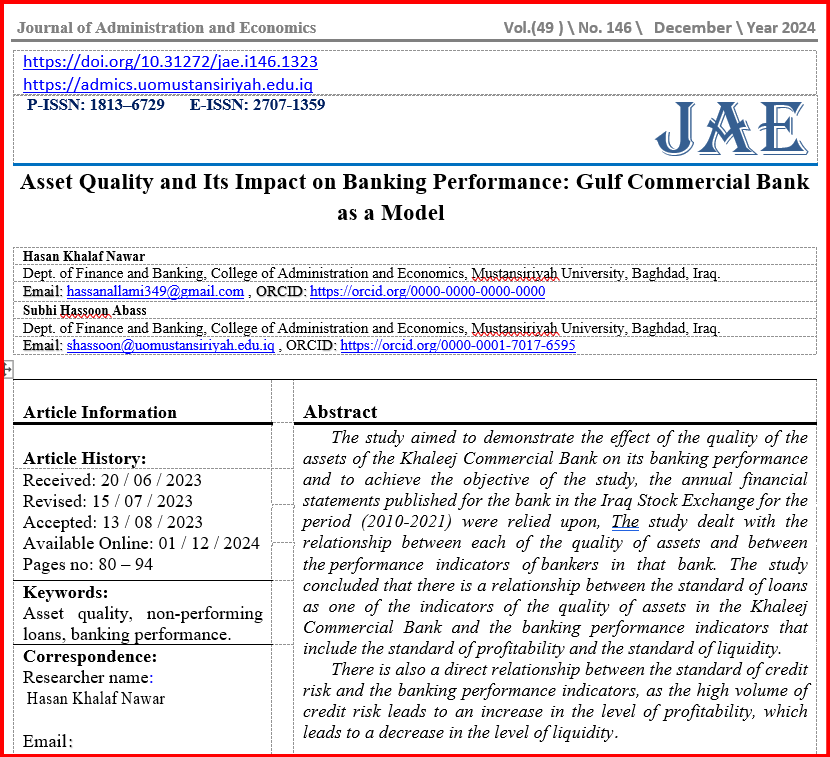
Asset Quality and Its Impact on Banking Performance: Gulf Commercial Bank as a Model
DOI:
https://doi.org/10.31272/jae.i146.1323Keywords:
Asset quality, non-performing loans, banking performanceAbstract
The study aimed to demonstrate the effect of the quality of the assets of the Khaleej Commercial Bank on its banking performance and to achieve the objective of the study, the annual financial statements published for the bank in the Iraq Stock Exchange for the period (2010-2021) were relied upon. The study dealt with the relationship between each of the quality of assets and between the performance indicators of bankers in that bank. The study concluded that there is a relationship between the standard of loans as one of the indicators of the quality of assets in the Khaleej Commercial Bank and the banking performance indicators that include the standard of profitability and the standard of liquidity. There is also a direct relationship between the standard of credit risk and the banking performance indicators, as the high volume of credit risk leads to an increase in the level of profitability, which leads to a decrease in the level of liquidity.
Downloads
References
[1] Abata, M. A. (2014). Asset quality and bank performance: A study of commercial banks in Nigeria. Research Journal of Finance and Accounting, 5(18), 39–44.
[2] Abusharbeh, M. (2020). The financial soundness of the Palestinian banking sector: An empirical analysis using the CAMEL system. (Unpublished manuscript). DOI: https://doi.org/10.21511/bbs.15(1).2020.09
[3] Affana, M. K. (2015). Bank credit management (1st ed.). Dar Al-Yazouri Publishing and Distribution.
[4] Abu Qamar, M. A. M. (2009). Evaluating the performance of Bank of Palestine Ltd. using the balanced scorecard [Master’s thesis, University of Gaza].
[5] Akani, H. W., & Akani, V. (2018). Theoretical perspectives of earnings, profitability and asset quality in banking: Descriptive evidence from Nigeria economy. World Journal of Finance and Investment Research, 3(1), 1–24.
[6] Al-Dhabhawi, H., & Tuwaij, A. A. R. (2022). Analyzing the reality of non-performing loans in the Iraqi banking sector for the period 2010-2019. Journal of Kufa Studies Center, 2(67), 1–38.
[7] Al-Fawazi, M. A. D. (2015). The traditional system and the CAMELS system for evaluating the financial performance of banks: A comparative study of a sample of private commercial banks for the period 2007-2013 [Master’s thesis, University of Basra].
[8] Al-Husseini, F. H., & Al-Douri, M. A. (2008). Bank management: A contemporary quantitative and strategic approach. Wael Publishing House.
[9] Al-Karassneh, I. (2010). Essential and contemporary frameworks for bank supervision and risk management. Economic Policy Institute – International Monetary Fund (IMF).
[10] Al-Khafaji, M. H. H. (2019). The effect of market risk on default and some liquidity indicators for banks: An applied study on a sample of Iraqi commercial banks (2005–2017) [Master’s thesis, University of Karbala].
[11] Al-Mahmoud, H. (2014). The possibility of using the CAMELS system to evaluate profitability quality in Islamic banks: An applied study [Master’s thesis, University of Damascus].
[12] Al-Sultan, Q. S. A. (2021). The extent of working capital management's response to non-operating assets and its impact on bank fragility: An analytical study of a sample of banks listed on the Iraq Stock Exchange (2011-2019) [Doctoral dissertation, University of Al-Qadisiyah].
[13] Al-Zubaidi, H. M. (2002). Bank credit management and credit analysis (1st ed.). Al-Warraq Publishing and Distribution Foundation.
[14] Apatachioae, A. (2015). The performance, banking risks and their regulation. Procedia Economics and Finance, 20, 35–43. https://doi.org/10.1016/S2212-5671(15)00293-2 DOI: https://doi.org/10.1016/S2212-5671(15)00044-1
[15] Arif, A., & Anees, A. N. (2012). Liquidity risk and performance of banking system. Journal of Financial Regulation and Compliance, 20(2), 182–195. https://doi.org/10.1108/13581981211218559 DOI: https://doi.org/10.1108/13581981211218342
[16] Bin Mahmoud, A. D. M., & Salah, A. (2019). The impact of asset management efficiency and quality on the profitability of Libyan commercial banks during the period from 2012 to 2017. Scientific Journal for Commercial and Environmental Studies, 10(2), 531–560.
[17] Cheruiyot, R. K. (2016). The effect of asset quality on the profitability of commercial banks in Kenya [Doctoral dissertation, University of Nairobi].
[18] Daft, R. L. (2001). Organization theory and design (7th ed.). South-Western.
[19] Dang, U. (2011). The CAMEL rating system in banking supervision: A case study [Master’s thesis].
[20] Dincer, H., Gencer, G., Orhan, N., & Sahinbas, K. (2011). A performance evaluation of the Turkish banking sector after the global crisis via CAMELS ratios. Procedia - Social and Behavioral Sciences, 24, 1530–1545. https://doi.org/10.1016/j.sbspro.2011.09.117 DOI: https://doi.org/10.1016/j.sbspro.2011.09.051
[21] Frost, S. M. (2004). Chapter 20: Corporate failures and problem loans. The bank analyst's handbook: Money, risk and conjuring tricks. John Wiley and Sons.
[22] Kadioglu, E., & Ocal, N. (2017). Effect of the asset quality on the bank profitability. International Journal of Economics and Finance, 9(7), 60–68. https://doi.org/10.5539/ijef.v9n7p60 DOI: https://doi.org/10.5539/ijef.v9n7p60
[23] Majumder, M. T. H., & Rahman, M. M. (2017). A camel model analysis of selected banks in Bangladesh. (Unpublished manuscript). DOI: https://doi.org/10.2139/ssrn.3068004
[24] Mashkoor, S. J., & Flayeh, M. R. (2020). The impact of capital adequacy, asset quality, and liquidity on the sustainability of profits in commercial banks. Tikrit Journal of Administrative and Economic Sciences, 16(52), 105–122. DOI: https://doi.org/10.25130/tjaes.16.52.2.6
[25] Ongore, V. O., & Kusa, G. B. (2013). Determinants of financial performance of commercial banks in Kenya. International Journal of Economics and Financial Issues, 3(1), 237–252.
[26] Othman, M. D. (2013). Credit and risk management and analysis (1st ed.). Dar Al-Fikr Publishing and Distribution.
[27] Rahim, A. F. (2014). The importance of the CAMELS system in evaluating the performance of banks in Iraq. Journal of Baghdad College of Economic Sciences University, (39), 26–56.
[28] Ramadan, Z., & Joudeh, M. (2006). Contemporary trends in bank management (3rd ed.). Wael Publishing and Distribution House.
[29] Rihab, F. A. Q., Enqitah, F. A., & Mahmoud, T. A. (2019). The impact of information technology on the performance of Libyan commercial banks. Journal of Economic and Political Sciences, (13).
[30] Zedan, K. A., & Gassan, D. A. A. S. (2017). Palestinian banks analysis using CAMEL model. International Journal of Economics Financial Issues, 7(1), 351–357. https://doi.org/10.6007/ijefi/v7-i1/2567
Downloads
Published
Issue
Section
License
Copyright (c) 2024 Hasan Khalaf Nawar, Subhi Hassoon

This work is licensed under a Creative Commons Attribution 4.0 International License.
The journal of Administration and Economics is an open- access journal that all contents are free of charge. Articles of this journal are licensed under the terms of the Creative Commons Attribution International Public License CC-BY 4.0 (https://creativecommons.org/licenses/by/4.0/legalcode) that licensees are unrestrictly allowedto search, download, share, distribute, print, or link to the full text of the articles, crawl them for indexing and reproduce any medium of the articles provided that they give the author(s) proper credits (citation). The journal allows the author(s) to retain the copyright of their published article.
Creative Commons-Attribution (BY)