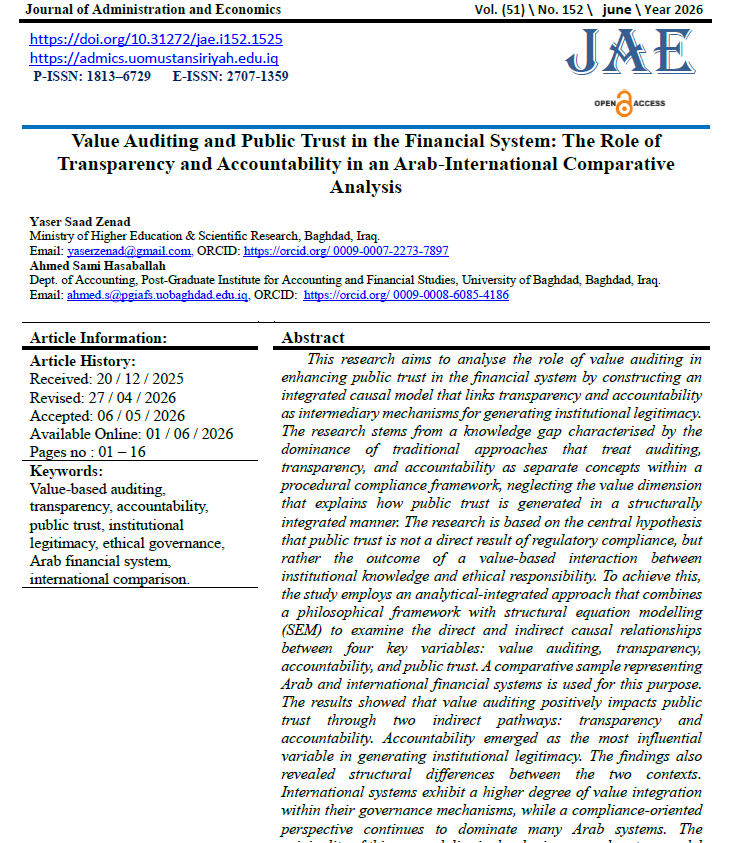
Value Auditing and Public Trust in the Financial System: The Role of Transparency and Accountability in an Arab-International Comparative Analysis
DOI:
https://doi.org/10.31272/jae.i152.1525Keywords:
Value-based auditing,, transparency,, accountability,, public trust,, institutional legitimacy,, ethical governance,, Arab financial system,, international comparison,Abstract
This research aims to analyse the role of value auditing in enhancing public trust in the financial system by constructing an integrated causal model that links transparency and accountability as intermediary mechanisms for generating institutional legitimacy. The research stems from a knowledge gap characterised by the dominance of traditional approaches that treat auditing, transparency, and accountability as separate concepts within a procedural compliance framework, neglecting the value dimension that explains how public trust is generated in a structurally integrated manner. The research is based on the central hypothesis that public trust is not a direct result of regulatory compliance, but rather the outcome of a value-based interaction between institutional knowledge and ethical responsibility. To achieve this, the study employs an analytical-integrated approach that combines a philosophical framework with structural equation modelling (SEM) to examine the direct and indirect causal relationships between four key variables: value auditing, transparency, accountability, and public trust. A comparative sample representing Arab and international financial systems is used for this purpose. The results showed that value auditing positively impacts public trust through two indirect pathways: transparency and accountability. Accountability emerged as the most influential variable in generating institutional legitimacy. The findings also revealed structural differences between the two contexts. International systems exhibit a higher degree of value integration within their governance mechanisms, while a compliance-oriented perspective continues to dominate many Arab systems. The originality of this research lies in developing an explanatory model that integrates the value dimension with quantitative analysis to measure the indirect impact of auditing on public trust. This contributes to redefining auditing as a mechanism for producing institutional legitimacy. The study recommends integrating public values into auditing standards, enhancing interactive transparency, and developing accountability models that reflect the ethical responsibility of the financial system towards society.
Downloads
References
[1] Zelizer, V. A. (2021). The social meaning of money: Pin money, paychecks, poor relief, and other currencies (Updated ed.). Princeton University Press. https://openlibrary.org/books/OL34272449M/Social_Meaning_of_Money DOI: https://doi.org/10.2307/j.ctv1t1kg6k
[2] OECD. (2023). Building trust, shaping policy, connecting globally: Annual report 2023. OECD Publishing. https://www.businessatoecd.org/hubfs/Building%20Trust%20Shaping%20Policy%20Connecting%20Globally%20-%20Annual%20Report%202023%20WEB.pdf
[3] Power, M. (2022). EY global audit quality report 2022. Ernst & Young. https://www.ey.com/content/dam/ey-unified-site/ey-com/en-gl/insights/trust/documents/ey-2022-global-audit-quality-report.pdf
[4]de Graaf, G., & van der Wal, Z. (2023). Enhancing the effectiveness of public sector performance regimes: A proposed causal model for aligning governance design with performance logics. Perspectives on Public Management and Governance, 6(1), 54–65. https://doi.org/10.1080/14719037.2021.2006973 DOI: https://doi.org/10.1093/ppmgov/gvac026
[5]Al-Hassan, A., & El-Said, H. (2022). The impact of the financial stability governance framework and communication strategies on the fluctuation of the financial cycle in the Arab region. Arab Monetary Fund. https://www.amf.org.ae/sites/default/files/publications/2022-09/The%20Impact%20of%20the%20financial%20final.pdf
[6]IMF. (2024). Annual Report 2024. International Monetary Fund. https://www.imf.org/external/pubs/ft/ar/2024/
[7]Habermas, J. (1996). Between facts and norms: Contributions to a discourse theory of law and democracy (W. Rehg, Trans.). MIT Press. https://mitpress.mit.edu/9780262581622/between-facts-and-norms/ DOI: https://doi.org/10.7551/mitpress/1564.001.0001
[8]Bryson, J. M., Crosby, B. C., & Bloomberg, L. (2017). Public value governance: Moving beyond traditional public administration and the New Public Management. Public Administration Review, 77(4), 546–561. https://doi.org/10.1111/puar.12838 DOI: https://doi.org/10.1111/puar.12838
[9]Zenad, Y. S., Hasaballah, A. S., & Shlaka, J. K. (2020). Promoting the dimensions of sustainable development in tourism using social auditing. African Journal of Hospitality, Tourism and Leisure, 9(1), 1–18. https://www.ajhtl.com/uploads/7/1/6/3/7163688/article_48_vol_9_1__2020_iraq.pdf
[10]Rawlins, B. (2022). Measuring the relationship between organizational transparency and employee trust. Journal of Public Relations Research, 21(1), 71–99. https://scholarsarchive.byu.edu/facpub/885/ DOI: https://doi.org/10.1080/10627260802153421
[11]Bovens, M. (2021). Updating public accountability: A conceptual framework of voluntary accountability. Public Management Review, 25(6), 1128–1151. https://doi.org/10.1080/14719037.2021.2006973 DOI: https://doi.org/10.1080/14719037.2021.2006973
[12]Suchman, M. C. (1995). Managing legitimacy: Strategic and institutional approaches. Academy of Management Review, 20(3), 571–610. https://doi.org/10.2307/258788 DOI: https://doi.org/10.2307/258788
[13]Bushman, R. M., & Williams, C. (2022). Transparency, financial accounting information, and corporate governance. Federal Reserve Bank of New York. https://www.newyorkfed.org/medialibrary/media/research/epr/03v09n1/0304bush.p
[14]Francis, R. (2023). PwC Transparency Report 2023. PricewaterhouseCoopers LLP. https://www.pwc.co.uk/transparencyreport/assets/pdf/uk-transparency-report-2023.pdf
[15] Hasaballah, A. S., Zenad, Y. S., & Shlaka, J. K. (2019). The role of fundamental analysis in determining the market value of hospitality, tourism and company shares. African Journal of Hospitality, Tourism and Leisure, 8(4), 1–15. https://www.ajhtl.com/uploads/7/1/6/3/7163688/article_60_vol_8_4__2019_iraq.pdf
Downloads
Published
Issue
Section
License
Copyright (c) 2026 Ahmed Sami Hasaballah & Yaser Saad Zenad

This work is licensed under a Creative Commons Attribution 4.0 International License.
The journal of Administration and Economics is an open- access journal that all contents are free of charge. Articles of this journal are licensed under the terms of the Creative Commons Attribution International Public License CC-BY 4.0 (https://creativecommons.org/licenses/by/4.0/legalcode) that licensees are unrestrictly allowedto search, download, share, distribute, print, or link to the full text of the articles, crawl them for indexing and reproduce any medium of the articles provided that they give the author(s) proper credits (citation). The journal allows the author(s) to retain the copyright of their published article.
Creative Commons-Attribution (BY)