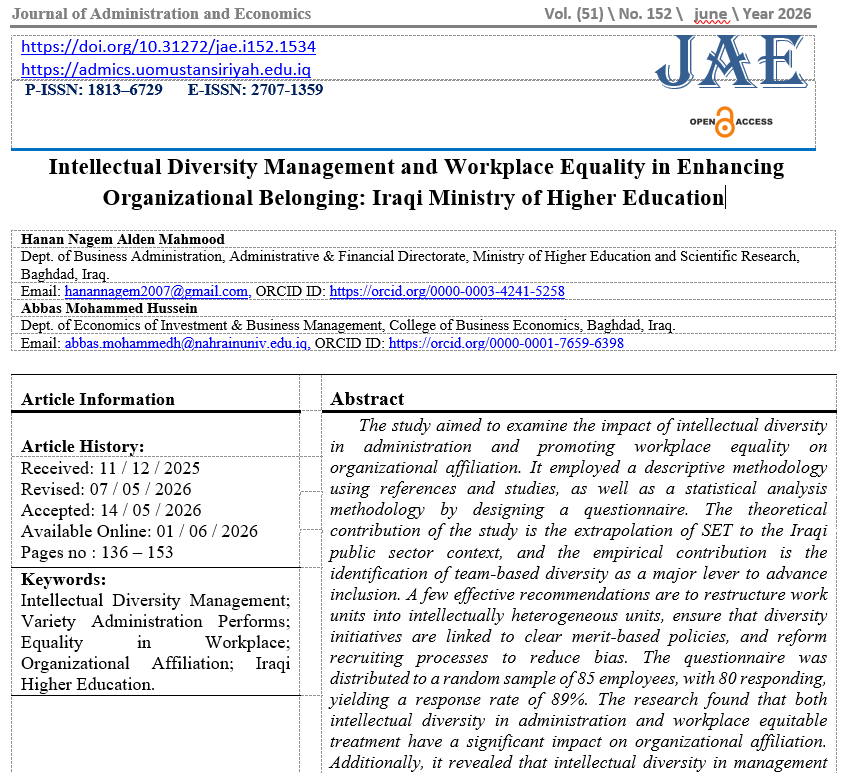
Intellectual Variety Managing Performs & Equality Promotion in Workplace & Their Impact on Organizational Belonging: An Empirical Study in Iraqi Ministry of Higher Education and Scientific Research
DOI:
https://doi.org/10.31272/jae.i152.1534Keywords:
Intellectual Diversity Management, Variety Administration Performs, Equality in Workplace, Organizational Affiliation, Iraqi Higher EducationAbstract
The study aimed to examine the impact of intellectual diversity in administration and promoting workplace equality on organizational affiliation. It employed a descriptive methodology using references and studies, as well as a statistical methodology of analysis by designing a questionnaire. The questionnaire was distributed to a random sample of 85 employees, with 80 employees responding, resulting in a response rate of 89%. The research found that both intellectual diversity in administration and workplace equitable treatment possesses a significant impact on organizational affiliation. Additionally, it revealed that intellectual diversity in management has a significant influence on workplace equality. Furthermore, workplace quality plays a crucial role in enhancing the relationship between intellectual diversity in management and organizational affiliation. Therefore, the study recommends that the Iraqi Ministry of Higher Education and Scientific Research maintain this strategic orientation towards intellectual diversity and maintain policies for attracting and appointing human competencies that are intellectually and skillfully diverse, and develop training and development systems in addition to developing reward and incentive systems that encourage intellectual diversity and implementing fair and transparent policies in assigning jobs, promotions and compensation.
Downloads
References
1. Allen, N. J., & Meyer, J. P., The measurement and antecedents of affective, continuance and normative commitment to organization. Journal of Occupational Psychology 63(1), 1–18 (2018). DOI: https://doi.org/10.1111/j.2044-8325.1990.tb00506.x
2. Ashforth, B. E., & Mael, F., Social identity theory and the organization. Academy of Management Review 14(1), 20–39 (2017). DOI: https://doi.org/10.2307/258189
3. Bakker, A. B., & Demerouti, E., Job demands-resources theory: Taking stock and looking forward. Journal of Occupational Health Psychology 22(3), 273–285 (2017). DOI: https://doi.org/10.1037/ocp0000056
4. Blake, R., & Thomas, D. A., Managing diversity and inclusion: An international perspective (Routledge, 2016).
5. Brewster, C., Chung, C., & Sparrow, P., Globalizing human resource management (Routledge, 2016).
6. Chung, H., & van der Meer, M., The role of salary transparency in promoting equity and equality. Human Resource Management Review 28(4), 436–446 (2018).
7. Cox, T., & Blake, S., Managing cultural diversity: Implications for organizational competitiveness. The Executive 5(3), 45–56 (1991). DOI: https://doi.org/10.5465/ame.1991.4274465
8. Cropanzano, R., & Mitchell, M. S., Social exchange theory: An interdisciplinary review. Journal of Management 31(6), 874–900 (2005). DOI: https://doi.org/10.1177/0149206305279602
9. Elamin, A. M., & Omair, K., Gender and career development: The case of Saudi women. Career Development International 15(4), 336–355 (2010).
10. Ely, R. J., & Thomas, D. A., Cultural diversity at work: The effects of diversity on performance and leadership. Academy of Management Journal 63(1), 118–146 (2020).
11. Fujimoto, Y., & Tsumori, T., Transparency and accountability in workplace equality practices. International Journal of Human Resource Management 30(1), 94–115 (2019).
12. Harter, J. K., Schmidt, F. L., & Hayes, T. L., Business-unit-level relationship between employee satisfaction, employee engagement, and business outcomes: A meta-analysis. Journal of Applied Psychology 87(2), 268–279 (2002). DOI: https://doi.org/10.1037/0021-9010.87.2.268
13. Homan, A. C., van Knippenberg, D., van Kleef, G. A., & De Dreu, C. K., Bridging the divide: The effects of communication and interaction on the relationship between diversity and team performance. Journal of Applied Psychology 103(1), 1–13 (2018).
14. Kahn, W. A., Theoretical perspectives on work and the work environment (Routledge, 2018).
15. Kraus, M. W., & Callaghan, J., The influence of social identity on perceptions of organizational diversity management. Journal of Organizational Behavior 40(5), 523–542 (2019).
16. Kulik, C. T., Diversity and inclusion in work organizations (Routledge, 2014).
17. McLoughlin, S., O'Connell, P. J., & Walsh, P., Investigating workplace complaints and their impact on organizational culture. Journal of Business Ethics 173(1), 37–53 (2021)
18. Meyer, J. P., & Allen, N. J., Commitment in the workplace: Theory, research, and application (Sage Publications, 2017).
19. Nishii, L. H., & Mayer, D. M., The role of organizational culture in managing diversity: A review and future directions. Journal of Management 48(4), 897–931 (2022).
20. Page, S. E., The difference: How the power of diversity creates better groups, firms, schools, and societies (Princeton University Press, 2007). DOI: https://doi.org/10.1515/9781400830282
21. Reade, C., Organizational identification and job satisfaction: The role of organizational culture. Journal of Management Studies 53(6), 987–1008 (2016).
22. Roberson, Q. M., Managing workplace diversity and inclusion: A psychological perspective (Routledge, 2019).
23. Saks, A. M., Job satisfaction and employee engagement: A meta-analysis (Routledge, 2019). DOI: https://doi.org/10.4324/9780429325755-12
24. Shore, L. M., Cleveland, J. N., & Sanchez, D., Inclusive workplaces: A review and model. Human Resource Management Review 21(1), 1–13 (2011).
25. Van Dick, R., Wagner, U., Stellmacher, J., & Christ, O., The role of perceived member status in organizational identification and organizational commitment. Journal of Applied Psychology 93(5), 1183–1196 (2008).
Downloads
Published
Issue
Section
License
Copyright (c) 2026 Hanan Nagem Alden Mahmood AL-Dulaimi, Abbas Mohammed Hussein Hussein

This work is licensed under a Creative Commons Attribution 4.0 International License.
The journal of Administration and Economics is an open- access journal that all contents are free of charge. Articles of this journal are licensed under the terms of the Creative Commons Attribution International Public License CC-BY 4.0 (https://creativecommons.org/licenses/by/4.0/legalcode) that licensees are unrestrictly allowedto search, download, share, distribute, print, or link to the full text of the articles, crawl them for indexing and reproduce any medium of the articles provided that they give the author(s) proper credits (citation). The journal allows the author(s) to retain the copyright of their published article.
Creative Commons-Attribution (BY)