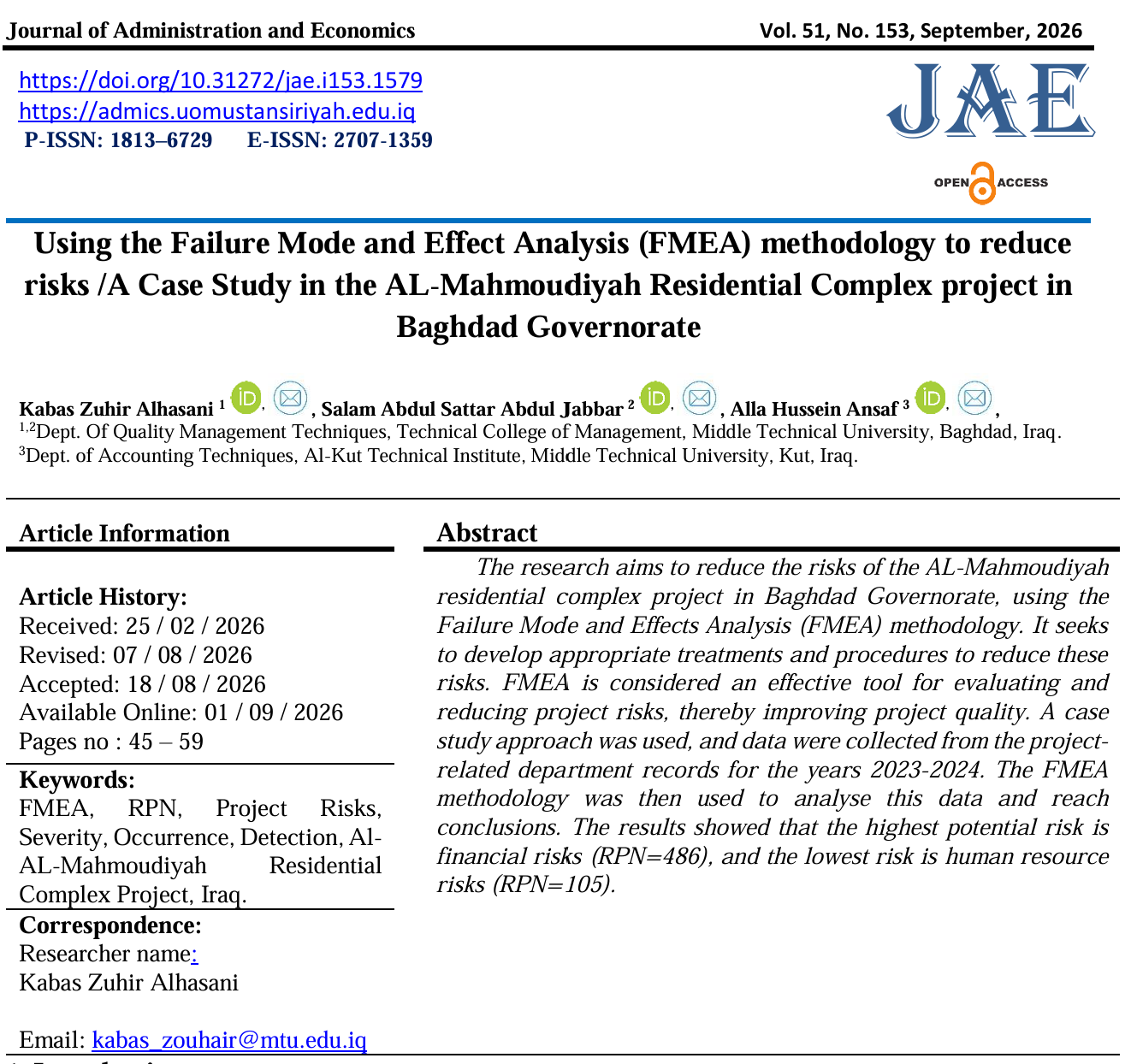
Using the Failure Mode and Effect Analysis (FMEA) methodology to reduce risks /A Case Study in the AL-Mahmoudiyah Residential Complex project in Baghdad Governorate
DOI:
https://doi.org/10.31272/jae.i153.1579Keywords:
FMEA, RPN, Project Risks, , Severity, Occurrence, Detection,, Al-Mahmoudiyah Residential Complex Project, Iraq.Abstract
The research aims to reduce the risks of the Al-Mahmoudiyah residential complex project in Baghdad Governorate, using the Failure Mode and Effects Analysis (FMEA) methodology. It seeks to develop appropriate treatments and procedures to reduce these risks. FMEA is considered an effective tool for evaluating and reducing project risks, thereby improving project quality. A case study approach was used, and data was collected from the project-related department records for the years 2023-2024. The FMEA methodology was then used to analyze this data and reach conclusions. The results showed that the highest potential risk is financial risks (RPN=486), and the lowest risk is labor risks (RPN=105).
Downloads
References
The research aims to reduce the risks of the Al-Mahmoudiyah residential complex project in Baghdad Governorate, using the Failure Mode and Effects Analysis (FMEA) methodology. It seeks to develop appropriate treatments and procedures to reduce these risks. FMEA is considered an effective tool for evaluating and reducing project risks, thereby improving project quality. A case study approach was used, and data was collected from the project-related department records for the years 2023-2024. The FMEA methodology was then used to analyze this data and reach conclusions. The results showed that the highest potential risk is financial risks (RPN=486), and the lowest risk is labor risks (RPN=105).
Downloads
Published
Issue
Section
License
Copyright (c) 2026 Kabas Zuhir Alhasani , Salam Abdul Sattar Abdul Jabbar , Alla Hussein Ansaf

This work is licensed under a Creative Commons Attribution 4.0 International License.
The journal of Administration and Economics is an open- access journal that all contents are free of charge. Articles of this journal are licensed under the terms of the Creative Commons Attribution International Public License CC-BY 4.0 (https://creativecommons.org/licenses/by/4.0/legalcode) that licensees are unrestrictly allowedto search, download, share, distribute, print, or link to the full text of the articles, crawl them for indexing and reproduce any medium of the articles provided that they give the author(s) proper credits (citation). The journal allows the author(s) to retain the copyright of their published article.
Creative Commons-Attribution (BY)