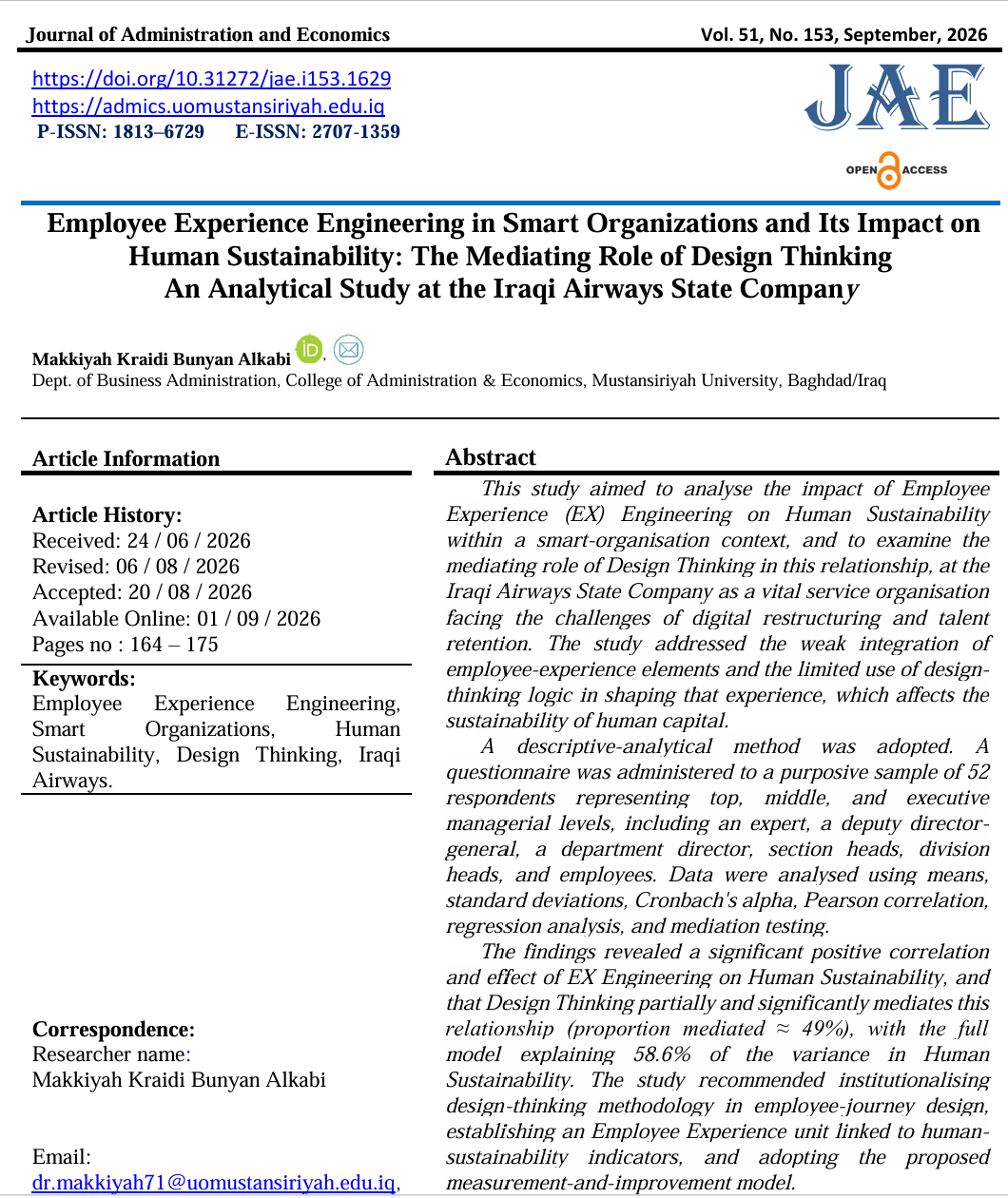
Employee Experience Engineering in Smart Organizations and Its Impact on Human Sustainability: The Mediating Role of Design ThinkingAn Analytical Study at the Iraqi Airways State Company
DOI:
https://doi.org/10.31272/jae.i153.1629Keywords:
Employee Experience Engineering, Human Sustainability, Design Thinking, Iraqi Airways.Abstract
this study aimed to analyze the impact of employee experience (EX) engineering on human sustainability within a smart -organization context , and to examine the mediating role of design thinking in this relationship , at the Iraqi Airways state company as vital service organization facing the challenges of digital restructuring and talent retention the study addressed the problem of the weak integration of employee -experience elements and the limited use of design thinking logic in shaping that experience , which affects the sustainability of human capital .
a descriptive -analytical method was adopted . aquestionnaire was administered to a purposive sample of 52 respondents representing top , middle , and executive managerial levels , including an expert, a deputy directore-general , adepartment director, section heads , division heads ,and employee . data were analyzed using means , standard deviations ,cronbach,s alpha ,pearson correlation ,regression analysis ,and mediation testing .
the finding revealed a significant positive correlation and effect of EX enginereeing on human sustainability and that design thinking partially and significantly mediates this relationship (proportion mediated =49%), with the full model explaining 58.6% of the variance in human sustainability . the study recommended institutionalizing design -thinking methodology in employee -journey design , establishing an employee experience unit linked to human -sustainability indicators , and adopting the proposed measurement -and - improvement model .
Downloads
References
[1] Morgan, J. (2017). The employee experience advantage: How to win the war for talent by giving employees the workspaces they want, the tools they need, and a culture they can celebrate. Wiley.
[2] Plaskoff, J. (2017). Employee experience: The new human resource management approach. Strategic HR Review, 16(3), 136–141.
[3] Itam, U., & Ghosh, N. (2020). Employee experience management: A new paradigm shift in HR thinking. International Journal of Human Capital and Information Technology Professionals, 11(2), 39–49.
[4] Andrés Reina, M. P., Díaz-Muñoz, R., & Rodríguez-Fernández, M. (2024). Employee experience: A systematic review. European Public & Social Innovation Review, 9, 1–20. https://doi.org/10.31637/epsir-2024-398
[5] Bai, B. (2025). Exploring sustainable HRM through the lens of employee wellbeing. Sustainability, 17(12), Article 5646. https://doi.org/10.3390/su17125646
[6] Chomać-Pierzecka, E., Dyrka, S., Kokiel, A., & Urbańczyk, E. (2024). Sustainable HR and employee psychological well-being in shaping the performance of a business. Sustainability, 16(24), Article 10913. https://doi.org/10.3390/su162410913
[7] Brown, T. (2008). Design thinking. Harvard Business Review, 86(6), 84–92.
[8] Brown, T. (2009). Change by design: How design thinking transforms organizations and inspires innovation. Harper Business.
[9] Schlott, C. K. (2024). Design thinking and teamwork—Measuring impact: A systematic literature review. Journal of Organization Design, 13, 163–196. https://doi.org/10.1007/s41469-024-00177-x.
[10] Peretz, H. (2024). Sustainable human resource management and employees’ performance: The impact of national culture. Sustainability, 16(17), Article 7281. https://doi.org/10.3390/su16177281
[11] Pfeffer, J. (2010). Building sustainable organizations: The human factor. Academy of Management Perspectives, 24(1), 34–45.
[12] Baron, R. M., & Kenny, D. A. (1986). The moderator–mediator variable distinction in social psychological research. Journal of Personality and Social Psychology, 51(6), 1173–1182.
[13] Sobel, M. E. (1982). Asymptotic confidence intervals for indirect effects in structural equation models. Sociological Methodology, 13, 290–312.
Downloads
Published
Issue
Section
License
Copyright (c) 2026 Makkiyah Kraidi Bunya Alkaby

This work is licensed under a Creative Commons Attribution 4.0 International License.
The journal of Administration and Economics is an open- access journal that all contents are free of charge. Articles of this journal are licensed under the terms of the Creative Commons Attribution International Public License CC-BY 4.0 (https://creativecommons.org/licenses/by/4.0/legalcode) that licensees are unrestrictly allowedto search, download, share, distribute, print, or link to the full text of the articles, crawl them for indexing and reproduce any medium of the articles provided that they give the author(s) proper credits (citation). The journal allows the author(s) to retain the copyright of their published article.
Creative Commons-Attribution (BY)