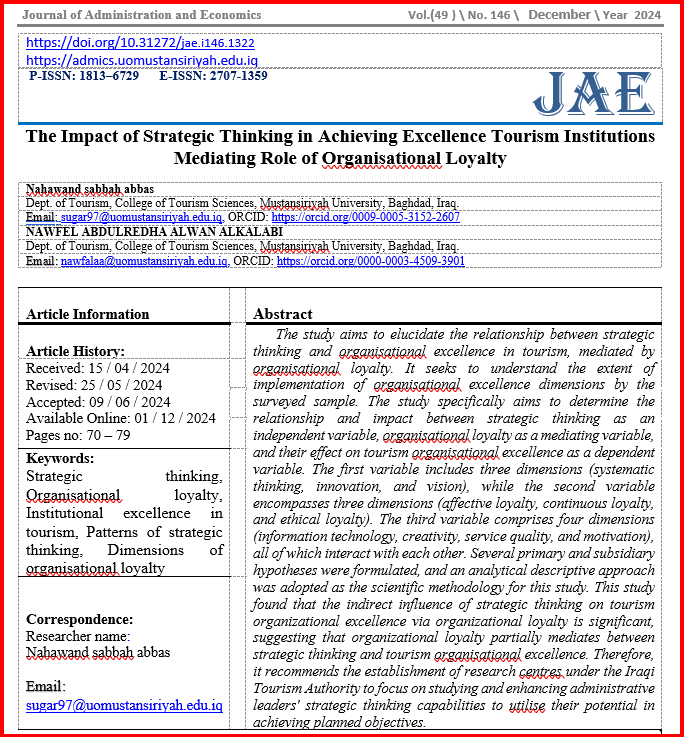
The Impact of Strategic Thinking in Achieving Excellence Tourism Institutions Mediating Role of Organisational Loyalty
DOI:
https://doi.org/10.31272/jae.i145.1322Keywords:
Strategic thinking, Organisational loyalty, Institutional excellence in tourism, Patterns of strategic thinking, Dimensions of organisational loyaltyAbstract
The study aims to elucidate the relationship between strategic thinking and organisational excellence in tourism, mediated by organisational loyalty. It seeks to understand the extent of implementation of organisational excellence dimensions by the surveyed sample. The study specifically aims to determine the relationship and impact between strategic thinking as an independent variable, organisational loyalty as a mediating variable, and their effect on tourism organisational excellence as a dependent variable. The first variable includes three dimensions (systematic thinking, innovation, and vision), while the second variable encompasses three dimensions (affective loyalty, continuous loyalty, and ethical loyalty). The third variable comprises four dimensions (information technology, creativity, service quality, and motivation), all of which interact with each other. Several primary and subsidiary hypotheses were formulated, and an analytical descriptive approach was adopted as the scientific methodology for this study. This study found that the indirect influence of strategic thinking on tourism organizational excellence via organizational loyalty is significant, suggesting that organizational loyalty partially mediates between strategic thinking and tourism organisational excellence. Therefore, it recommends the establishment of research centres under the Iraqi Tourism Authority to focus on studying and enhancing administrative leaders' strategic thinking capabilities to utilise their potential in achieving planned objectives.
Downloads
References
[1] Abidin, Nor Zaini Zainal & Saidon, Mohd Kasri & Salamat, Azni Syafena Andin (2022), "Organizational Loyalty: A study in Relation of Ethical Accountability and Public Trust in local government", journal of administrative science, vol 19, isuue 1.
[2] Adam, Mukharuddin & Kesuma, Meldi (2021), "The role of organizational commitment in Mediating the effect of job characteristics and organizational support on employee loyalty Muhammadiyah Aceh university , international journal of business management and economic review, vol 4, no 2. DOI: https://doi.org/10.35409/IJBMER.2021.3243
[3] Abuzaid, A (2016), "Testing the Impact of Strategic Leadership organization Ambidexterity: A Field Study on the Jordanian Chemical Manufacturing Companies", International journal of business and Management, vol . 11, No 5. DOI: 10.5539/ijbm.v11n5p328 DOI: https://doi.org/10.5539/ijbm.v11n5p328
[4] Akhtar, C. S., Awan, S. H., Naveed, S., & Ismail, K (2018), "A comparative study of the application of systems thinking in achievement organizational effectiveness in Malaysian and Pakistani banks", International Business Review, vol 27, No 4. DOI: 10.1016/j.ibusrev.2018.01.001 DOI: https://doi.org/10.1016/j.ibusrev.2018.01.001
[5] Ali, Fakhri Abbadi (2022). Strategic Alignment and Its Impact on Achieving Organizational Creativity: An Applied Study in the Ministry of Education Headquarters / General Directorate of Education of Baghdad Karkh First / Abu Ghraib Education Department. Journal of Business Economics, Vol. 2, No. 1, Baghdad.
[6] Ali, Karim Nasir (2017). Organizational Loyalty Among Al-Mustansiriya University Teaching Staff. Journal of Basic Education College, Vol. 23, No. 97, Baghdad. DOI: 10.35950/cbej.v23i97.8
[7] Allen, N & Meyer, J (2004), "Tcm Employee commitment Survey Academic Users Guide", London Ontario, Canada : university of Western Ontario, Department of Psychology.
[8] Al-Bahadli, Karrar Jasim Kadhim (2020). Personal Styles and Their Impact on Achieving Guest Satisfaction: An Applied Study on a Sample of First-Class Hotels in Baghdad City. (Master's Thesis, Al-Mustansiriya University, College of Communication Sciences, Baghdad).
[9] Al-Hammadi, Bashir Mohammed & Assif, Hail Saeed Ali (2023). The Impact of Using the Balanced Scorecard on Achieving Institutional Excellence: An Analytical Study of the Opinions of a Sample of Employees at the Yemen University of Science and Technology. Journal of Al-Qalam University College, Vol. 7, No. 14, Yemen.
[10] Al-Laozi, Khadija Mohammed (2012). Emotional Intelligence Levels of Secondary School Principals and Their Effect on Teachers' Organizational Loyalty in the Capital Governorate of Amman. (Master's Thesis in Educational Administration and Leadership, Middle East University, Faculty of Educational Sciences, Amman).
[11] Al-Omari, Hani Abdullah (2021), Strategic planning concepts in light of the criteria for the excellence Award Procedures and evaluation criteria , Riyadh, Saudi council for quality.
[12] Al-Saadi, Talib Lifta Mohammed (2017).The Impact of Strategic Thinking on the Quality of Hotel Service: An Applied Study on Premier Hotels in Baghdad City. (Master's Thesis, Al-Mustansiriya University, College of Tourism Sciences, Baghdad).
[13] Ana, Lilian, (2016), What is the effect of size on the use of the EFQM excellence model?, international journal of operations & production management, vol (36), no12. DOI: https://doi.org/10.1108/IJOPM-11-2014-0557
[14] Bonn I, (2005), Improving Strategic thinking: a multilevel approach", Leadership & Organization Development", journal, vol. 26, no. 1. DOI: https://doi.org/10.1108/01437730510607844
[15] Boussalem, Abu Bakrm, (2014), "Impact of employees Empowerment on Organizational Loyalty-case study on Algerian communications company, vol 2, no 7. DOI: https://doi.org/10.12816/0011610
[16] Correia, Fabio Daniel, Carvalho, Andre M., Allen, Nicola Campbell and Paulo Sampaio (2018), A new approach to organizational excellence for small and medium enterprises: the QOE-SME model, journal total Quality management & business excellence, vol 32. DOI: https://doi.org/10.1080/14783363.2020.1718490
[17] Dionisio, Marcelo (2017), "Strategic Thinking: The Role in Successful Management", journal of management Research. DOI: 10.5296/jmr.v9i4.11448 DOI: https://doi.org/10.5296/jmr.v9i4.11448
[18] Eketu, C.A., & Ogbu Edeh PhD, F. (2015), "Promoting employee loyalty through organizational learning A study of selected hospitality firms in Port Harcourt, Nigeria. IOSR journal of business and management. DOI: 10.9790/487X-171123944
[19] Frempong, L.N., Agbenyo, W., & Darko, P.A (2018), "The impact of job satisfaction on employees loyalty and commitment: a comparative study among some selected sectors in Ghana", European Journal of business and management, 10 (12).
[20] Hammoud, Khudair Kadhim (2005). Total Quality Management. Dar Al Masirah for Publishing and Distribution, Amman. (Book).
[21] Hammoud, Zainab Arkan (2018). Characteristics of Strategic Thinking and Their Role in Work Productivity: An Applied Research in the National Insurance Company. (Higher Diploma, University of Baghdad, Higher Institute for Accounting and Financial Studies, Financial Studies Department, Insurance Specialization, Baghdad).
[22] Hatim, Firas Naji (2023). The Impact of Organizational Climate on Organizational Loyalty in Tourism Institutions: An Exploratory Study of Colleges of Tourism Sciences in Baghdad and Karbala. Nassag Journal, Vol. 37, No. 7, Baghdad.
[23] Heijden, K (2005), "Scenarios the art of Strategic Conversation", 2th edition, John Wiley & SonsLtd, Printed and bound in Great Britain by TJ International Ltd, Padstow, Cornwal.
[24] Jaroslav Nenadal & David Vykydal & David Waloszek (2018), Organizational Excellence : Approaches models and theiruse at Czech organizations quality Innovation Prosperity. DOI: https://doi.org/10.12776/qip.v22i2.1129
[25] Jumaa, Mahmoud Hassan (2017). The Impact of Information Technology on Banking Performance: An Applied Study on a Sample of Government Banks in Diyala Governorate. Tikrit Journal of Administrative and Economic Sciences, Vol. 19, Special Issue, Tikrit.
[26] Muhammad, Nasreen Jasim & Shnaiter, Abdul Rahman Tahir (2015). The Relationship Between Quality of Work Life and Organizational Creativity: An Applied Research in the General Bureau of the Ministry of Planning. Journal of Economic and Administrative Sciences, Vol. 21, No. 81, Baghdad. DOI: 10.33095/jeas.v21i81.547 DOI: https://doi.org/10.33095/jeas.v21i81.547
[27] Najem, Hussein Abdul Jabbar (2023). The Role of Strategic Thinking in Enhancing Institutional Excellence: An Exploratory Study of a Number of Employees in the Departments Affiliated with the General Directorate of Education in Nineveh Governorate. Kirkuk University Journal of Administrative and Economic Sciences, Vol. 13, No. 2, Kirkuk. DOI: 10.32894/1913-013-002-029 DOI: https://doi.org/10.32894/1913-013-002-029
[28] Oweida, Ihab Ahmed (2008). The Impact of Job Satisfaction on Organizational Loyalty among Employees in Non-Governmental Organizations in Gaza Governorates. (Master's Thesis in Business Administration, Islamic University, Faculty of Commerce, Business Administration Department, Palestine).
[29] Qatami, Naifa (2015). Curricula and Methods for Teaching the Gifted and Talented. 1st Ed., Dar Al Masirah for Publishing and Distribution, Amman, Jordan. (Book).
[30] Tawfiq, Abdul Rahman (2016). Motivation and Work Incentives. Professional Expertise Center for Management, Training and Publishing, Cairo. (Book).
Downloads
Published
Issue
Section
License
Copyright (c) 2024 Nahawand sabbah abbas, NAWFEL ABDULREDHA ALWAN ALKALABI

This work is licensed under a Creative Commons Attribution 4.0 International License.
The journal of Administration and Economics is an open- access journal that all contents are free of charge. Articles of this journal are licensed under the terms of the Creative Commons Attribution International Public License CC-BY 4.0 (https://creativecommons.org/licenses/by/4.0/legalcode) that licensees are unrestrictly allowedto search, download, share, distribute, print, or link to the full text of the articles, crawl them for indexing and reproduce any medium of the articles provided that they give the author(s) proper credits (citation). The journal allows the author(s) to retain the copyright of their published article.
Creative Commons-Attribution (BY)