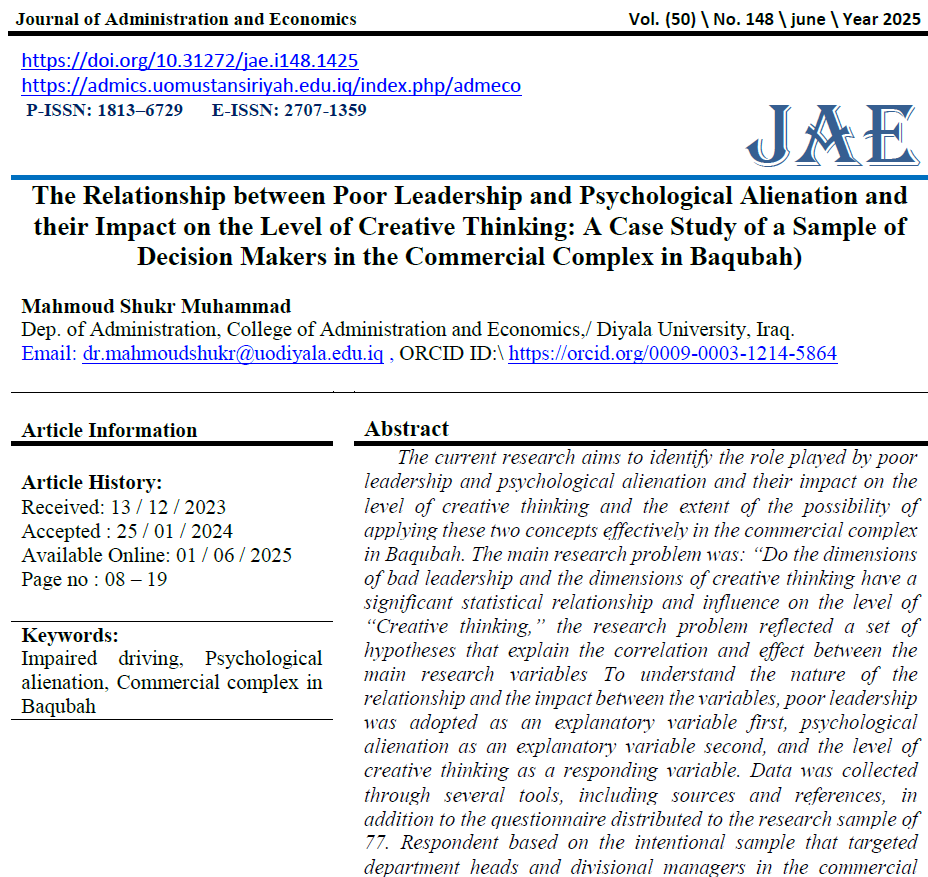
The Relationship between Poor Leadership and Psychological Alienation and their Impact on the Level of Creative Thinking: A Case Study of a Sample of Decision Makers in the Commercial Complex in Baqubah)
DOI:
https://doi.org/10.31272/jae.i148.1425Keywords:
Impaired driving, Psychological alienation, Commercial complex in BaqubahAbstract
The current research aims to identify the role played by poor leadership and psychological alienation and their impact on the level of creative thinking and the extent of the possibility of applying these two concepts effectively in the commercial complex in Baqubah. The main research problem was: “Do the dimensions of bad leadership and the dimensions of creative thinking have a significant statistical relationship and influence on the level of “Creative thinking,” the research problem reflected a set of hypotheses that explain the correlation and effect between the main research variables To understand the nature of the relationship and the impact between the variables, poor leadership was adopted as an explanatory variable first, psychological alienation as an explanatory variable second, and the level of creative thinking as a responding variable. Data was collected through several tools, including sources and references, in addition to the questionnaire distributed to the research sample of 77. Respondent based on the intentional sample that targeted department heads and divisional managers in the commercial complex in Baqubah, and in light of the data and information collected from the research sample, the data was analysed. Hypotheses were tested using appropriate statistical tools and analysed through several ready-made statistical programs (SPSS, ver19), and also contributed Statistical tools related to statistical analysis (arithmetic mean, standard deviation, honesty coefficient, linear regression coefficient, influence and correlation values) in arriving at accurate results. The research reached an essential set of conclusions, the most important of which was that there is an inverse relationship, meaning that poor leadership may have a noticeable effect on the level of creative thinking. This indicates the role of poor leadership in not encouraging and not enhancing creative thinking within the mall. The research results reflected a set of recommendations, which stated that the leadership of the mall should focus on developing leadership skills and improving management methods to enhance the satisfaction and performance of the work team.
Downloads
References
[1] Abbas, A. (2004). Fundamentals of management science. Dar Al-Masirah for Publishing and Distribution, Amman.
[2] Abdel-Baqi, S. D. M. (2020). Organizational behavior. Al-Dar Al-Jami'yah, Egypt.
[3] Al-Obaidi, M. A. S. (2013). Empowerment strategy and its role in enhancing the quality of supervisory work: An analytical study of the views of a sample of financial supervisors at the Financial Control Bureau (Unpublished diploma thesis). University of Mosul.
[4] Al-Omari, H. A. (2007). Organizational development and reorganization: Business notes. College of Economics and Management.
[5] Al-Shammari, A. (2017). The role of the internal work environment in achieving organizational commitment (Master's thesis). Naif Arab University.
[6] Al-Taie, A. H. (2021). Building intellectual capital between empowerment management and strategic decision resource effectiveness. Journal of Economic and Administrative Sciences, 11(39).
[7] Al-Tayyib, M. R. (2018). Theory: An introduction to management, fundamentals, functions, techniques. University Publications Office, Algeria.
[8] Awad, A. M. (2012). The role of knowledge management and its technologies in achieving organizational development. Damascus University Journal of Economic and Legal Sciences, 28(1).
[9] Buraib, T. (2019). Administrative control and its relationship to organizational development (Master's thesis in Business Administration). College of Humanities and Social Sciences, Mohamed Khider Biskra University, Algeria.
[10] Chuang, H., & Tsai, P. (2010). The Impact of Leadership Styles on Job Stress and Turnover Intention: Taiwan Insurance Industry as an Example. Department of Business Management, Tatung University.
[11] Harrison, J. (2011). Interview with Linda Holbeche and Mee–Yan Cheung-Judge, authors of Organizational Development. Development and Learning in Organizations: An International Journal, 25(5), 39–42. DOI: https://doi.org/10.1108/14777281111159447
[12] Kuraidi, B. (2010). Leadership styles and their impact on organizational commitment. Al-Qadisiyah Journal of Administrative and Economic Sciences, 12(3).
[13] Meier, O. (2009). Dico du manager: 500 clés pour comprendre et agir. Dunod.
[14] Muhammad, U. (2004). Methods and approaches of organizational development. Business administration research.
Downloads
Published
Issue
Section
License
Copyright (c) 2025 Mahmoud Shukr Muhammad

This work is licensed under a Creative Commons Attribution 4.0 International License.
The journal of Administration and Economics is an open- access journal that all contents are free of charge. Articles of this journal are licensed under the terms of the Creative Commons Attribution International Public License CC-BY 4.0 (https://creativecommons.org/licenses/by/4.0/legalcode) that licensees are unrestrictly allowedto search, download, share, distribute, print, or link to the full text of the articles, crawl them for indexing and reproduce any medium of the articles provided that they give the author(s) proper credits (citation). The journal allows the author(s) to retain the copyright of their published article.
Creative Commons-Attribution (BY)